How to Test a Mattress Before Buying: What to Do In Store
Share
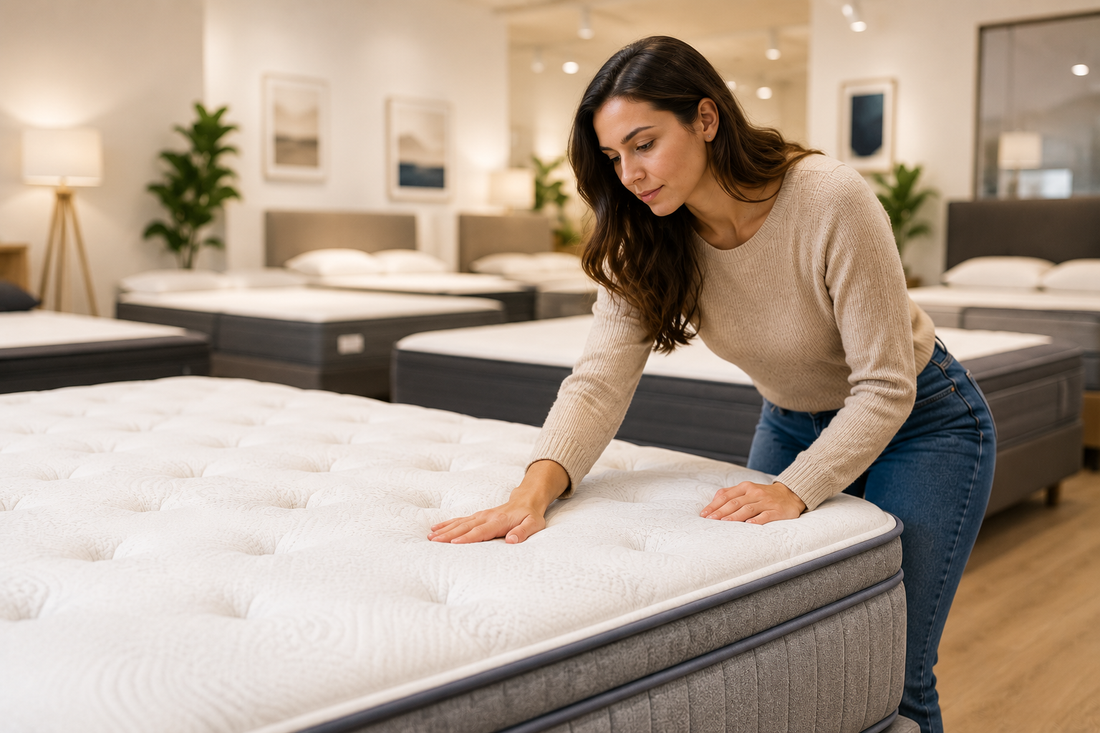
Testing a mattress in store is one of the most useful things you can do before committing to a purchase — but it's also one of the most commonly misunderstood parts of the buying process. A quick 60-second lie-down doesn't reveal how a mattress will feel after 30 nights of sleep. Sitting on the edge for a moment doesn't test the surface you'll actually be sleeping on. And browsing five mattresses in ten minutes doesn't give you meaningful comparison data. If you're planning a showroom visit, the way you test matters as much as the mattress you're testing.
This guide walks through how to properly test a mattress in store — how long to lie down, what positions to try, what to check for, what questions to ask, and what mistakes to avoid. It also covers what an in-store test can and can't tell you, and how our 120-night sleep trial complements the showroom visit for a genuinely low-risk buying decision. If you're heading to a mattress showroom (ours or anyone else's), this is the methodology worth taking with you.
When testing a mattress in store, spend at least 10-15 minutes lying in your usual sleeping position, assess comfort and support, change positions naturally, and compare multiple mattresses before deciding. In-store testing helps narrow your options — but a short showroom visit can't fully replicate sleeping at home. Our 120-night sleep trial lets you continue the evaluation in your own bed after purchase, so the showroom visit and the sleep trial work together.
Key takeaways
-
Lie down on each mattress for at least 10-15 minutes — a quick test doesn't reveal how a mattress will actually feel
-
Test in your usual sleeping position (side, back, stomach, or combination) rather than a "showroom pose"
-
Compare at least 3-5 mattresses in the same session so you have meaningful reference points
-
In-store testing narrows your options; a proper sleep trial (like our 120-night trial) confirms the fit
-
If you can't visit a showroom, a substantial sleep trial makes online mattress buying genuinely low-risk
Why testing a mattress in store matters
Every sleeper experiences mattresses differently. The same mattress can feel medium to one person and firm to another, plush to one sleeper and unsupportive to another. Reviews and marketing tell you what a mattress claims to be — but personal comfort is subjective, and only your own body can confirm the fit.
A showroom visit gives you something that no review, no spec sheet, and no video can: the direct experience of lying on the mattress with your actual body weight in your actual sleeping position. Even 10-15 minutes of proper testing reveals things marketing can't communicate — how the surface feels under your specific pressure points, whether your spine feels aligned, how the mattress responds when you change position.
In-store testing works best when you use it as a narrowing tool. Rather than picking one mattress and buying immediately, use the showroom to move from a long list of possibilities to a short list of finalists. Then confirm the final choice with a proper sleep trial at home. This combined methodology — showroom to narrow, sleep trial to confirm — is what turns a high-stakes purchase into a low-risk one.
One caveat worth acknowledging upfront: many Australian buyers can't easily visit a mattress showroom. If you're in a regional area, or the brands you're considering are online-only, or you simply don't have time for a showroom visit, that's fine. A quality sleep trial makes online mattress buying genuinely low-risk. The rest of this article gives you the methodology for in-store testing if you can visit — and helps you understand what the sleep trial provides if you can't.
How to test a mattress before buying
The step-by-step methodology.
1. Wear comfortable clothing.
Loose, non-restrictive clothes let you feel the mattress the way you would when sleeping. Avoid tight jeans, structured jackets, or anything that changes how your body weight distributes across the surface.
2. Remove bulky jackets and shoes.
Extra layers and shoes distort your body weight distribution. Take them off before you lie down. Salespeople expect this — you're not being rude.
3. Lie down for at least 10-15 minutes.
This is the single most important part of testing. A 60-second lie-down doesn't reveal pressure points, temperature buildup, or alignment issues. Set a mental timer and stay put for the full 10-15 minutes on each mattress you're seriously considering.
4. Test in your usual sleeping position.
Side, back, stomach, or a combination — mimic your actual sleep style. Don't lie flat on your back staring at the ceiling if you're a side sleeper who curls up. The mattress needs to work for how you actually sleep.
5. Roll over naturally.
Test how easily you can change position. Combination sleepers especially benefit from checking this — a mattress that traps you in one position will feel wrong at 2am when you try to roll over.
6. Sit on the edge.
Sit at the perimeter of the mattress. Then lie down near the edge. Check how the mattress performs when you're not in the centre — this matters for anyone who sits on the bed to put on shoes, or for couples who each use one side of the bed.
7. Compare several mattresses.
Don't decide after testing one. Test at least 3-5 in the same session so you have reference points. A mattress feels different when you have something to compare it to. First impressions from a single test are unreliable.
The process matters more than the pace. Slow down. The person selling to you understands why you're taking your time — they'd rather you buy the right mattress once than the wrong one twice.
___________
What should you look for?
Six factors to notice during your test.
Comfort. Does the mattress feel welcoming at the surface? Or do you feel pressure at your shoulders, hips, or lower back within a few minutes?
Support. Does your spine feel like it's in a neutral position? You shouldn't feel like you're sinking too deeply (hips lower than shoulders), and you shouldn't feel like your lower back is arched away from the surface. A neutral, straight spinal line is what to check for.
Pressure relief. After 5-10 minutes, do you feel pressure points forming? Side sleepers especially should notice their shoulder and hip. If pressure builds early in the test, it'll build faster during actual sleep.
Motion isolation. If you're testing with a partner, does one person's movement transfer across the bed? Have your partner shift positions while you're on the other side — you should barely feel it if the motion isolation is good.
Edge support. Sit and lie near the edge of the mattress. Does the mattress hold up firmly, or does it collapse under weight? Weak edge support matters for anyone who uses the full width of the bed or sits on the edge regularly.
Ease of movement. How easily can you change positions? Do you feel "stuck" in memory foam sink, or "hugged" too tightly to move naturally? A responsive surface reshapes quickly under position changes.
Continue learning:
-
What Makes a Good Mattress? — universal quality features
-
Motion Isolation Mattress — deeper coverage of the motion isolation feature
-
Mattress Layers Explained — how layers shape comfort and support
___________
Test the mattress in your normal sleeping position
Different sleeping positions reveal different aspects of the mattress. Test in the position(s) you actually sleep in.
Side sleepers.
Lie on your side for at least 5-10 minutes. Notice pressure at your shoulder and hip — the two heaviest contact points when lying on your side. Your spine should feel straight from shoulders to hips — check by having a partner or salesperson look at your alignment from behind. The mattress should conform enough to cushion the shoulder and hip without letting you sink so deeply that your spine curves at either end.
Back sleepers.
Lie on your back with your arms at your sides. Slide a hand under your lower back — you should feel light contact with the mattress, not a gap. A big gap suggests the mattress isn't supporting your lumbar curve. Your hips should sink slightly but not so much that your lower back arches. The whole length of your spine should feel supported without pressure points.
Stomach sleepers.
Lie face-down. The key check is whether your hips sink into the mattress — too much sinking arches your lower back and causes morning stiffness. Look for firmer surfaces that keep your hips level with your shoulders. If your hips feel like they're sinking deeper than the rest of your body, the mattress is too soft for stomach sleeping.
Combination sleepers.
Test every position you regularly sleep in. Then focus on how easily you can transition between them. Roll from your side to your back, from your back to your stomach — the mattress should reshape quickly under each change rather than trapping you in the previous position. Combination sleepers benefit most from responsive constructions.
If you sleep with a partner, both of you should test. What feels right for one sleeper often feels wrong for the other, and the mattress needs to work for both of you.
Continue learning: Best Mattress for Combination Sleepers.
___________
Questions to ask before you buy
Before committing to a purchase, ask (or look up) the following.
-
What is the firmness rating of this mattress? Where does it sit on the 1-10 scale?
-
What materials are used in each layer? Comfort layer, transition layer, support core — all three matter for how the mattress performs over time
-
Does it come with a sleep trial? How long, and what are the terms? A quality mattress brand should offer at least 100 nights. Ours is 120 nights
-
What's covered under warranty? Ten years is the standard for quality mattresses in Australia. Ours is a 10-year mattress warranty
-
Does the mattress work with adjustable bed bases? Relevant if you use or plan to use an adjustable base
-
Are the materials certified? Look for CertiPUR-US® for foam, GOLS for organic latex, and OEKO-TEX® for textiles
-
Is there return shipping cost if the mattress isn't right? Check the fine print of the trial policy
-
Can I try flipping or rotating the mattress? Some mattresses (like our Koala Mattress Core) are flippable; most aren't
Don't be afraid to ask. A good salesperson (or a good FAQ page on the brand's website) can answer these clearly. Vague answers are a signal to keep looking.
Why a showroom test isn't the whole story
Here's the reality of showroom testing.
A mattress can feel great after 5 minutes and wrong after 5 nights.
Showroom testing rewards mattresses that make an immediate impression. A plush surface at first touch, a supportive feel in the first minute — these register in the short-term test. But "impressive at first touch" isn't the same as "comfortable across 30 nights of sleep."
What you can't test in a showroom:
-
Body temperature over a full night. Mattresses that feel neutral for 15 minutes can sleep hot for 8 hours
-
Adjustment period. Foam mattresses often take 2-4 weeks for your body to settle into. Your first-night feel isn't your final-week feel
-
How your body actually distributes weight overnight. You shift positions 20-30 times during real sleep — showroom testing captures only a few of those positions
-
How the mattress performs across multiple nights. Pressure points, alignment issues, and temperature problems often emerge only over multiple nights
What a showroom test IS useful for:
-
Narrowing the field. Moving from 10 possibilities to 2-3 finalists is exactly what showroom testing is good at
-
Ruling out obvious mismatches. A mattress that feels wrong in 10 minutes will feel wrong in 10 nights
-
Building your reference points. Testing 5 mattresses side by side teaches you what firmness levels and constructions feel like — knowledge you use for the final decision
The reader-focused framing: treat the showroom visit as the first half of the buying decision. The sleep trial is the second half. Together, they give you a genuinely low-risk path to the right mattress.
___________
How Koala helps you choose with confidence
We designed our buying journey around the reality that in-store testing has value but limits — so we've built the process to work whether you can visit us in person or not.
Visit our Moore Park Showroom in Sydney.
If you're in Sydney or planning a visit, our showroom lets you experience our range in person. Luxe, Plus, Core, and SE — all in the same location, side by side. This is the direct comparison that lets you feel the actual differences between the plush top layer of the Koala Luxe, the cooling gel of the Koala Plus, the flippable design of the Koala Mattress (Core), and the entry-tier construction of the Koala SE.
Compare models side by side.
Because our range is all in the same showroom, you can move between mattresses in the same session — building the reference points that make comparison meaningful. Test the Luxe's 7 multi-layered support zones (per Luxe product page), the Plus's Cooling Gel Kloudcell® with CoolThread™ (13% cooler than leading online brands per Plus product page), the Core's flippable medium-firm / firm design, and the SE's CHOICE®-Recommended foam construction — all in one visit.
Continue your evaluation at home with our 120-night sleep trial.
In-store testing lets you narrow the field. Our 120-night sleep trial lets you confirm the fit in your own bed with your own sleep patterns. Together, they give you a genuinely low-risk path to the right mattress — the showroom test narrows your options; the sleep trial confirms the final choice over weeks of actual sleep.
If you can't visit our showroom, the 120-night trial alone gives you the same low-risk buying path. Many of our customers are in regional Australia, other cities, or interstate — the sleep trial is what makes buying online (from us or any brand offering a substantial trial) genuinely safe. Order the mattress you think fits, test it in your own bed for weeks, and confirm the choice — or return it if it isn't right.
What our range delivers alongside the buying process:
-
ProductReview Mattress of the Year 2023, 2024, 2025 three-year streak across the range
-
CertiPUR-US® certified Kloudcell® open-cell foam
-
120-night sleep trial
-
10-year mattress warranty
-
Australian design
___________
Common mistakes when testing a mattress
The mistakes that quietly wreck showroom visits.
|
Mistake |
Why it matters |
Better approach |
|
Sitting instead of lying down |
Sitting compresses the mattress differently — you can't assess sleep feel from a seated position |
Lie down properly. Sit at the edge only to test edge support |
|
Spending only a minute on each mattress |
Comfort issues (pressure points, temperature, alignment) often emerge only after 5-10 minutes |
Spend at least 10-15 minutes per mattress you're seriously considering |
|
Testing only one sleeping position |
Combination sleepers change positions across the night; the mattress needs to work for all positions |
Test every position you regularly sleep in |
|
Focusing only on firmness |
Firmness is one factor; construction, materials, motion isolation and edge support matter too |
Use the six-factor checklist to evaluate the full mattress |
|
Not comparing multiple mattresses |
A mattress feels different when you have nothing to compare it to |
Test at least 3-5 mattresses in the same session |
|
Ignoring the sleep trial |
Showroom testing narrows options; the sleep trial confirms the fit |
Combine both: shortlist in-store, confirm at home |
|
Being pressured by sales tactics |
Time-limited "deals" or high-pressure closers cloud judgment |
Take your time. A good mattress will still be a good mattress next week |
|
Not bringing your partner |
If you share a bed, the mattress needs to work for both sleepers |
Bring your partner and test together, especially for motion isolation |
___________
Our Koala mattress range
Our range covers four mattresses — all built on multi-layer Kloudcell® construction, each designed for a specific sleeper profile.
-
Koala Luxe — our premium option with 9cm Kloudcell® top layer + 7 multi-layered support zones (per Luxe product page)
-
Koala Plus — Cooling Gel Kloudcell® with CoolThread™ (13% cooler than leading online brands per Plus product page)
-
Koala Mattress (Core) — flippable medium-firm / firm; ProductReview Mattress of the Year 2023, 2024, 2025 three-year streak
-
Koala SE — CHOICE®-Recommended entry-tier
What every mattress in our range delivers:
-
CertiPUR-US® certified Kloudcell® open-cell foam
-
120-night sleep trial — test in your own bed for weeks
-
10-year mattress warranty
-
Australian design — our team designs from Sydney
-
Our Moore Park Showroom — for in-person testing (Sydney)
Two paths to the right mattress:
-
If you can visit our showroom — combine in-person testing with the 120-night sleep trial for the most thorough evaluation
-
If you can't visit — the 120-night trial alone gives you a low-risk way to buy online and test in your actual bed. Many of our customers buy this way
Testing a mattress well isn't about clever tricks or insider knowledge. It's about lying down long enough, testing in your actual sleeping position, comparing multiple options, and slowing down enough to notice how the mattress feels rather than how the marketing describes it. A showroom visit gives you real information — but not final information. The sleep trial is what turns "this feels good in the store" into "this is right for my sleep." Combine both when you can. Rely on the trial alone when you can't. Either way, the goal isn't a perfect showroom decision — it's a confident final one, made over weeks of actual sleep.
Experience Koala mattresses in person
If you'd like to test our range before deciding, visit our Moore Park Showroom in Sydney to compare the Koala Luxe, Koala Plus, Koala Mattress (Core), and Koala SE side by side. Our team can walk you through the differences and help you narrow your shortlist. If you can't visit in person, our 120-night sleep trial gives you time to test in your own bed with your actual sleep patterns. Every mattress comes with a 120-night trial and a 10-year warranty.
Still deciding which mattress is right for you? Explore our guides on Soft vs Medium vs Firm Mattress, Mattress Layers Explained, and How to Choose a Mattress to compare comfort, support, and construction before your visit.
To compare in person, visit our Moore Park Showroom in Sydney.


