L-Shaped & Sectional Sofa Guide: Sizing, Layout & Setup
Share
An L-shaped couch (also known as a sectional, corner, or modular sofa) is the most flexible seating option for modern Australian living rooms. The L-shape gives you more seating per square metre than a standard sofa, creates natural conversation zones, and works in rectangular, square, and open-plan rooms equally well. The trick is matching the right size, chaise direction, and configuration to your space.
An L-shaped couch has two sections meeting at a right angle — typically a main seat with a chaise extension. Standard Australian dimensions: long section 220–280 cm, chaise extension 150–180 cm, total depth around 240–290 cm. Position the long section along the longest wall, with the chaise extending into open space (never blocking walkways or doors). Modular options like Koala's Torquay and Bangalow Modular Sofas let you reconfigure the layout later, while the Koala Wanda Sofa Bed offers a reversible chaise that flips left or right.
Key Takeaways
-
An L-shaped couch has two sections meeting at a right angle — usually a main seat with a chaise extension.
-
Measure twice, buy once. Account for room dimensions, traffic flow, and doorway access before buying.
-
Left or right chaise? The chaise should extend into open space — never block walkways or doorways.
-
Modular sectionals let you reconfigure the layout — best for renters or anyone whose room shape may change.
-
What are Koala's L-shape options? The Torquay Modular Sofa - Chaise and Torquay Modular Sofa - Corner (modular with reversible chaise), the Bangalow Modular Sofa (Sofa / Chaise / Corner configurations, 2-Seater through 10-Seater), and the Wanda Sofa Bed [2nd Gen] (4-in-1 with reversible chaise and a slide-out queen bed).
This guide walks through sizing, layout, chaise direction, modular flexibility, and how to pair an L-shaped sofa with the rest of your living room furniture.
What Is an L-Shaped or Sectional Sofa?
An L-shaped couch is a sofa with two perpendicular sections that form an "L" shape. One section runs along a wall (the main seat); the other extends out at a right angle (typically as a chaise lounge or additional seats).
Terminology overview.
-
L-shaped: the most common term in Australia — describes any sofa in an L configuration
-
Sectional: the broader category — any sofa made from multiple connected sections, including L-shapes, U-shapes, and other arrangements
-
Corner sofa: another common Australian term, particularly for L-shaped sofas placed in a corner
-
Modular sofa: a sectional with reconfigurable pieces (you can rearrange the layout — e.g., Koala's Bangalow and Torquay Modular Sofas)
Common layouts.
-
L-shape with chaise: main seat + a wider section with no armrest, ideal for stretching out
-
L-shape with full seat extension: two main seating sections, no chaise
-
U-shape: three sections forming a U, larger and more enclosed
-
Modular: completely customisable — you choose how the modules fit together
Key differences from traditional couches. A standard sofa seats 2–4 people in a single straight line. An L-shaped sofa seats 4–6 people in two directions, encouraging conversation and providing more flexible lounging options.
Why are they popular. L-shaped sofas have become the default for new Australian living rooms because they:
-
Maximise seating in a single piece of furniture
-
Naturally define open-plan spaces (sofa back creates a "zone")
-
Offer chaise lounging (which standalone sofas don't)
-
Suit rectangular and L-shaped open-plan rooms
For a deeper look at modular variants, see our modular sofa guide.
Measuring Your Space for an L-Shaped Sofa
Sizing an L-shaped couch is the most common buying mistake. Too big and it dominates the room; too small and it looks lost.
Take accurate measurements. Measure:
-
Total room width and length
-
Wall length where the long section will sit
-
Distance from wall to nearest opposing furniture or wall
-
Doorway and hallway widths (for delivery)
Account for traffic flow and walkways. Spatial design guidance recommends at least 80 cm of walkway between the sofa and other major furniture (TV unit, bookshelves, doorways) — and ideally 90 cm if your room allows. Pinch points smaller than that make the room feel cramped.
Distance from walls. Push the long section right against the wall to maximise floor space. The chaise can either extend into the room or sit against an adjoining wall, depending on the configuration.
Window placement. Avoid placing the sofa back directly under a window if you can — it blocks light and looks awkward. If unavoidable, choose a low-back sofa.
Radiators and heat sources. Keep at least 30 cm between sofas and heat sources to protect the upholstery.
Quick rule-of-thumb distances:
|
Element |
Recommended distance |
|
Sofa to coffee table |
40–50 cm |
|
Sofa to TV |
200–300 cm (depending on TV size) |
|
Sofa to other furniture |
80 cm (walkway) |
|
Chaise extension into room |
At least 100 cm clearance beyond the chaise tip |
Standard L-shaped couch dimensions. Industry-standard sectional sofa measurements for Australian living rooms typically run:
-
Long section width: 220–280 cm
-
Chaise length: 150–180 cm (extending perpendicular)
-
Seat depth: 90–110 cm
-
Total back-to-front depth (including chaise): 240–290 cm
For Koala's recommendations, the Torquay Modular Sofa - Chaise (2-Seater Chaise, Regular section width) measures 232 cm wide × 109 cm deep × 77 cm high — within the standard L-shape range. The Wanda Sofa Bed [2nd Gen] sits at 252 cm wide × 175 cm deep with chaise.
If your room is under 3.5 × 3.5 m, look for compact L-shaped options — Koala's Bangalow Modular Sofa Sofa configuration starts at a compact 2-Seater (198 cm wide).
Left Chaise vs Right Chaise: Which Way?
This is one of the most common confusion points when buying an L-shaped couch online. Get it right and it slots perfectly into your room; get it wrong and you can't use the sofa as intended.
How to determine "left" or "right" chaise. Stand facing the sofa from the front (as you would when sitting down). The chaise extends to either your left or your right.
-
Left-arm-facing (LAF) chaise: chaise extends to your left when you stand in front of the sofa
-
Right-arm-facing (RAF) chaise: chaise extends to your right
How to measure for orientation. Imagine yourself sitting on the main section. Where does the chaise extend? It should extend into open space — not toward a doorway, not into a walkway, not against an opposing wall.
Traffic flow considerations. The chaise direction should never block:
-
The path between the sofa and the kitchen
-
The path to a hallway or other room
-
A doorway or main entry point
Entry point considerations. When you walk into the living room, the chaise should be visible (not hidden behind the sofa back) and inviting. This usually means the chaise extends toward the open part of the room.
Personal preference and household usage. Some households have habitual lounge positions — one person always uses the chaise side. If that's you, position the chaise on the side that suits the regular user.
Reversible chaise options solve this problem. Some Australian sofa designs let you switch the chaise direction at home. Koala's Wanda Sofa Bed [2nd Gen] has a reversible chaise that flips left or right (it's a fixed 4-in-1 sofa bed, but the chaise side is yours to choose). Koala's Torquay Modular Sofa - Chaise does the same on the modular side — the chaise can sit on either side of the sofa.
Arranging an L-Shaped Sofa in Different Room Shapes
Different room shapes call for different L-shaped layouts. Here's how to make the L work in any room:
Rectangular rooms
Position the long section along the longest wall, with the chaise extending into the room toward the centre or opposite wall. This is the most common and natural L-shape arrangement.
If the room is very long, consider:
-
A coffee table on the floor space created by the L
-
A console table behind the sofa back
-
Side tables at the chaise end
Square rooms
In square rooms, an L-shaped sofa can either:
-
Hug a corner (long section along one wall, chaise along the perpendicular wall) — maximises floor space but creates an enclosed feel
-
Float (long section along a wall, chaise extending into the room without touching another wall) — more sociable but uses more floor space
Rooms with corners blocked by doors/windows
If the natural corner is blocked, place the L-shape so the long section runs along a clear wall and the chaise extends into the room in the direction that doesn't block the doorway or window.
Small living spaces
For rooms under 12 m², look for:
-
Compact L-shapes (under 220 cm long section, under 150 cm chaise)
-
Floating placement rather than wall-hugging — counterintuitively, this can make small rooms feel less cluttered
-
Modular options that can be reconfigured if your needs change — Koala's Bangalow Modular Sofa starts at a compact 2-Seater (198 cm wide) and is fully reconfigurable
For more compact-living ideas, see our small bedroom ideas guide — many of the same principles apply to small living rooms.
Open-plan homes
L-shaped couches are particularly useful in open-plan living/dining spaces because the sofa back naturally creates a "zone" between the lounge area and the rest of the room. Position the sofa with its back to the dining/kitchen area to define the lounge space.
Modular and Sectional Flexibility
Modular L-shaped sofas (sometimes called configurable sectionals) take the basic L-shape and make it adaptable.
What modular sectionals offer.
-
Rearrangeability: swap the chaise from left to right, change L to U, separate into individual pieces
-
Expandability: add modules over time (e.g., extra seats, ottomans, additional sections)
-
Movability: each module is smaller than a one-piece sofa, fitting through narrow doorways and tight stairwells
Koala's modular L-shape options. Two product lines fit here:
-
Torquay Modular Sofa — available in Chaise, Corner, and U-Shape configurations, with Regular (80 cm) or Extra Wide (100 cm) section widths. The Chaise version has a reversible chaise; the Corner is a true L-shape (4-Seater Corner is 291 × 211 cm); the U-Shape is for larger lounges. Tool-free snap-together connectors make assembly and rearrangement straightforward.
-
Bangalow Modular Sofa — configurable as Sofa, Chaise, or Corner, available in sizes from 2-Seater up to 10-Seater. Fully replaceable covers (sold separately) let you refresh the look without replacing the sofa.
Adding or removing pieces. With both Torquay and Bangalow, you can start with a smaller configuration and add modules later as your home or family grows. Each module ships separately and connects without tools.
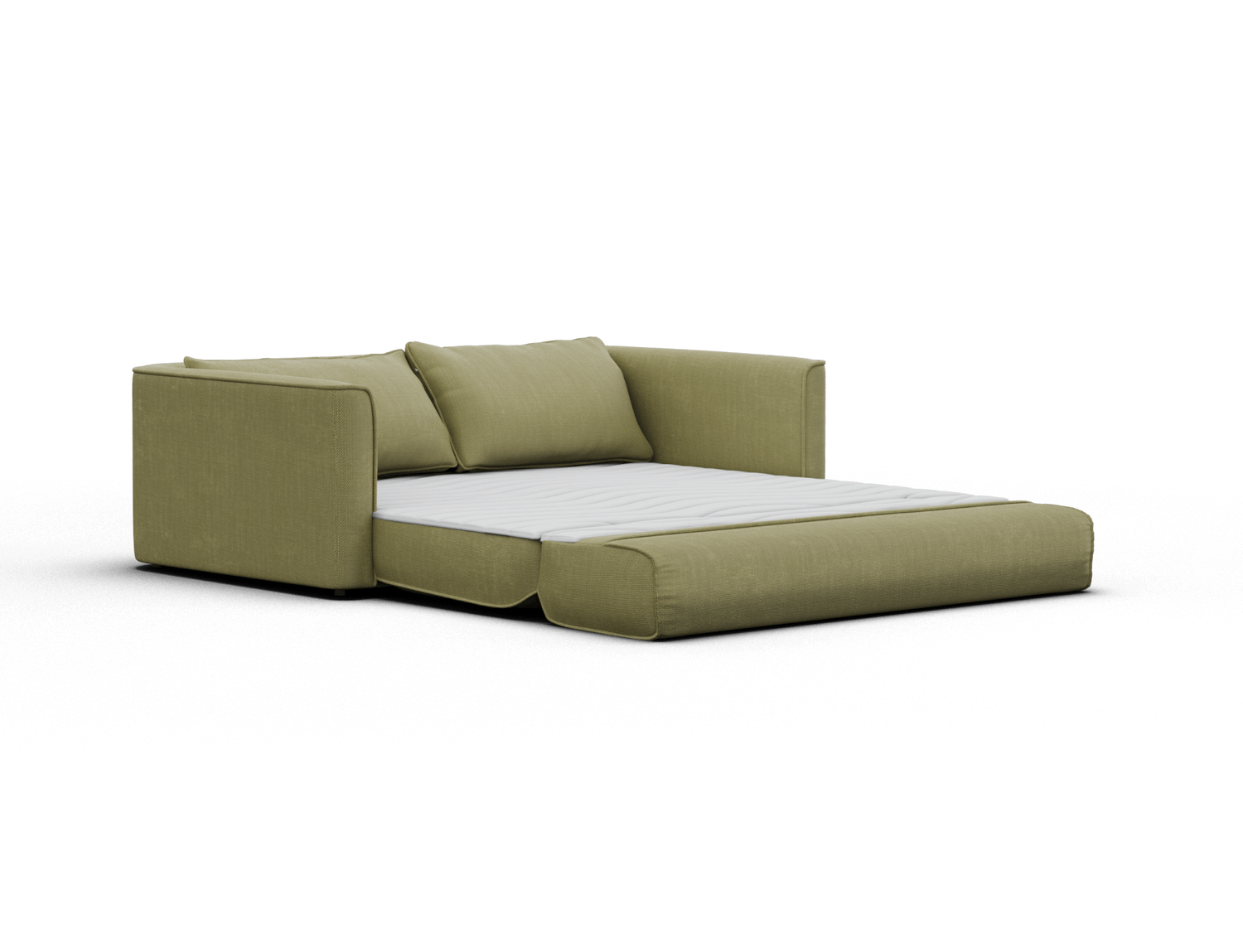
Sleeper options for L-shape buyers. If you also need a guest bed, the Wanda Sofa Bed [2nd Gen] is a 4-in-1 — sofa, chaise, daybed, and slide-out queen bed in one piece (252 cm wide, 4.8 average from 304 reviews). It's not modular (a fixed configuration), but it has a reversible chaise that flips to either side.
For a deeper dive into modular sofa design, see our modular sofa guide. For sofa bed-specific options, see our best sofa bed in Australia guide
Pairing L-Shaped Sofas with Other Furniture
The sofa is half the battle — the rest of the furniture needs to balance it.
Coffee table sizing and placement
A coffee table should be:
-
Two-thirds the length of the long sofa section (e.g., 150 cm sofa = ~100 cm coffee table)
-
Lower than the seat cushions by 5–10 cm
-
40–50 cm from the front of the sofa for comfortable reach without bumping knees
Square or rectangular coffee tables work well with L-shaped sofas, sitting in the floor space created by the L. Avoid round coffee tables that don't echo the sofa's geometry.
Side tables and accent furniture
Add a side table at the open end of the chaise for drinks, books, or a lamp. If the long section sits against a wall, you don't necessarily need a side table at that end — the wall serves the same purpose.
TV placement and viewing angles
Position the TV opposite the long sofa section (where most people sit) — not opposite the chaise. The chaise position is for relaxing; the main section is where everyone watches together.
Distance from sofa to TV depends on screen size:
-
55-inch TV: ~250 cm
-
65-inch TV: ~270 cm
-
75-inch TV: ~300 cm
Rug selection and layering
A rug under the L-shaped sofa anchors the seating area and adds warmth. Aim for:
-
A rug at least the size of the sofa's footprint (front legs of the sofa should sit on the rug)
-
A rug that extends 30–50 cm beyond the sofa edges
-
A neutral or low-contrast pattern to keep the focus on the sofa
For more on choosing the right fabric for your sofa, see our sofa fabric and cover guide [TBD: confirm slug at publish]. For day-to-day cleaning across fabric types, see our how to clean a sofa guide.
Ready to find your L-shaped sofa?
Modular flexibility or a 4-in-1 sofa bed — Koala's Torquay and Bangalow Modular Sofas and the Wanda Sofa Bed [2nd Gen] cover every L-shape brief. FSC® certified timber, 120 day trial, 5-year warranty.